




Synopsis: Early Child Care: Infants & Nations at Risk
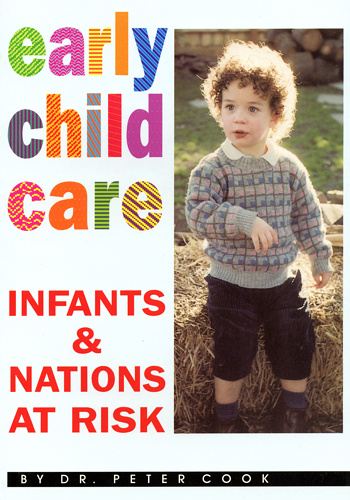
This book is written for concerned parents, students and policy-makers who wish to understand some of the issues involved in early child care from the point of view of what is best for infants, young children, their mothers and families, in order to promote optimum emotional health and well-being.
In recent times universally available and affordable non-parental child care, from an increasingly early age, has been advocated as part of an agenda to redress the inequalities experienced by women, by enabling them to participate in the paid workforce. However, non-maternal care in early childhood, by unrelated women having no lasting commitment to the child, is without successful precedent in the history of our species. A child can spend 12,500 hours in day care by the age of five. This is more than the 12,000 hours that he or she would spend at school during the next 12 years.
Concerns about the impact of this on infants and young children were countered by assurances that there was no evidence of harm from quality child care and in some cases it could be beneficial. In fact, there is accumulating robust evidence to suggest that risks of a variety of serious and probably lasting undesirable outcomes are associated with early group child care as it exists in reality, even in "high quality" child care. The many infants who are already disadvantaged in our society appear to be among those who are most at risk of further disadvantage when deprived of mothering in early group child care. Infants' actual experiences in real-life day care situations are often very different from the ideal picture.
This book presents some of the relevant child care research findings and their interpretation, in the light of the developmental needs of infants and their parents, while considering "baby's point of view" and the expressed wishes of many mothers. The evidence confirms that there are grounds for serious concerns about the direction of policies which effectively pressure mothers to separate from their babies and very young children by placing them in childcare, and policies which subsidize them to do this rather than caring for their infants and young children themselves.
The many contributions that home-caring mothers or fathers make to society are currently undervalued. Society offers them little in return, but they are penalized and handicapped on seeking to re-enter the work-force. Some remedial measures are suggested. The book calls for community recognition of infants and their parents as a discrete and vulnerable group, with special needs during a limited period, and suggests an examination of the most cost-effective ways of helping to meet the needs of parents in caring for their infants and young children.
The precautionary principle - first and foremost do no harm - should apply. There is good evidence to suggest that "there are many professionals in infant mental health who believe that children's best interests would be served by patterns of child care diametrically opposed to those politicians promise, policy-makers aspire to provide and parents strive to find" (Leach 1996b).
Dr. Peter S. Cook is a retired Sydney, Australia child and family psychiatrist, who writes on preventive child and family mental health. He is the author of Early Child Care: Infants and Nations at Risk (Melbourne: News Weekly Books, 1997).